Year's end weird book roundup
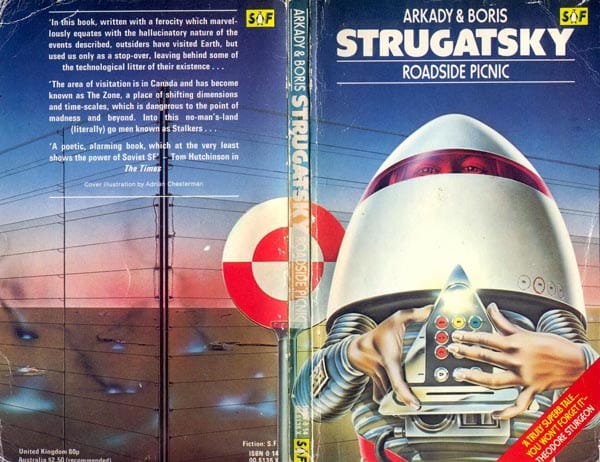
Hi everyone. As you can see, I haven't updated Paperback Picnic in a few months. I am still busy working on my second novel and don't expect to return to a regular posting schedule here any time soon. But I thought I'd do a brief roundup of the weird and/or old books I read in the second half of this year. All three of these are highly recommended. Merry Christmas!
Roadside Picnic (Arkady and Boris Strugatsky, 1972)
This is maybe not the first, but certainly the defining example of the sci-fi plot where an inexplicable alien Thing arrives on Earth, and humans try to make sense of it. In this case the thing in question is the Zone: a small town that suddenly, overnight, becomes cluttered with valuable and deadly alien objects that cannot be fathomed by human science.
This book is deservedly considered a classic, though it's overshadowed by the film adaptation (Stalker, 1979) and the videogames based on it. Having seen the film and played at least a little of the games, I came into this with a set of expectations, but the novel still managed to surprise me. Although the basic events are the same, here the alien weirdness of the Zone is leavened with a touch of absurdity, which both deflates and accentuates the uncanny nature of the Zone.
The first elements of the Zone that we're introduced to are fairly standard Mysterious Alien Objects. For example, there are zones of intense gravity that kill you, cylindrical objects held together by force fields, and intangible blobs of slime that kill you. (A lot of things in the Zone kill you.)
These things are unexplained by human science, but it at least seems possible that they could one day be understood. Later on, we are introduced to effects of the Zone that call into question the very principles of science itself. In one chapter, dead people start climbing out of their graves and returning to sit around in their family homes. In another, we learn that the locals who live near the Zone are forbidden from ever leaving: if they do, whatever city or region they move to will see a dramatic spike in accidents, plane crashes and suicides, in a sort of "statistical curse" that leaves scientists throwing up their hands in bewilderment.
Events like these are not just signs of the unknown; they hint that our entire understanding of material reality, cause and effect, is built on sand.
This theme of science challenged by the fundamentally inexplicable has of course become a mainstay of existential science fiction. You can see it, for example, in various SCP Foundation stories (here is one of my favourites); in the epistemic horror of qntm's There Is No Antimemetics Division; and in the ecological uncanny of Jeff VanderMeer's Southern Reach trilogy. In fact, you could say that the trope of the fundamentally inexplicable mystery has itself been codified and boxed up as just another plot device. Regardless, it's always fun to find that something "new" is actually old, that the old masters have been here long before us.
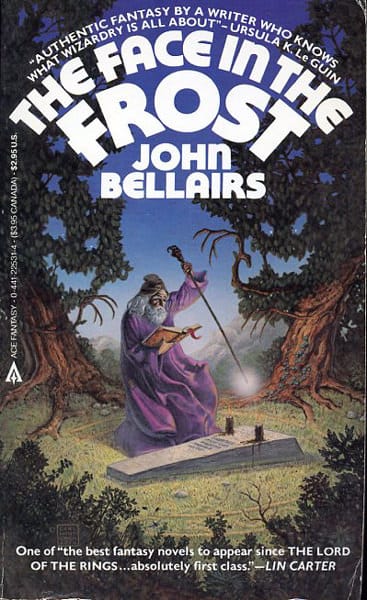
The Face in the Frost (John Bellairs, 1969)
A cosy fantasy novel from long before cosy fantasy was a thing. The story follows Prospero and Roger Bacon, two charmingly eccentric wizards, whose idyllic confirmed-bachelor lifestyle is threatened by the creeping intrusion of dark forces from outside.
When I say outside, I mean literally, outside Prospero's house. There is great attention paid in the first chapter to this house, how quaint and cosy it is, and the domestic joys it offers: a roaring fire, a cuckoo clock, a slice of cheese on bread. When darkness begins to intrude, it comes in a subtle and nightmarish fashion: a chill in the root cellar, a cold face glimpsed in the windowpane.
Throughout the book, warm interiors are contrasted against the cold world outside. (Almost every exterior scene takes place at night.) Some scenes are whimsical or even ridiculous (Prospero uses his magic mirror to scry into the future and watch the World Series) while others read like scenes from a horror novel. The two styles play off each other, humour and horror, darkness and light.
While I was actually reading this book, I can remember being a little impatient with it. The story is meandering and episodic, and there were times when I rolled my eyes at the introduction of yet another kooky character or bizarre town for the wizards to visit. But now, maybe three months after, I look back on it with utmost fondness. The scattered scenes are now tinged with a rosy glow, the images vivid and indelible. I feel quite sure I will return to it as a comfort read. With its motif of warmth and light surrounded by darkness, it would be a lovely book to read at Christmastime.
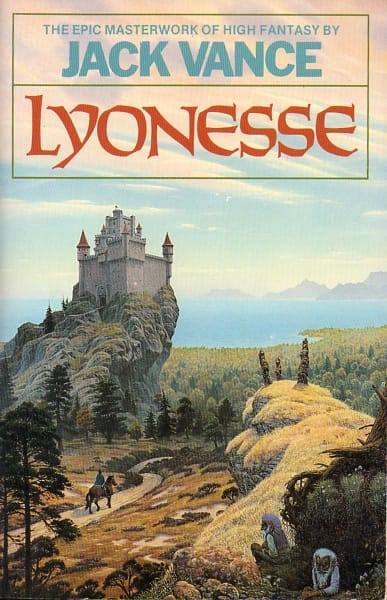
Lyonesse (Jack Vance, 1983)
My second re-read of Jack Vance's greatest novel. Sometimes I think this is simply the best fantasy novel of all time. It's certainly my personal favourite. A sweeping saga of kingdoms, warfare and wizards that also contains within it a down-and-dirty picaresque world, populated by countless thieves, knaves and charlatans... and within that, the world of the fairies, wicked and whimsical and deadly. (This book has the best fairies ever, full stop.)
The way this novel zooms in and out, from the perspective of kings and nobles, down into the lives of wandering orphans, then up again to the power struggles of immortal wizards centuries in the offing... it's just perfect. Telescopic, polyphonic, everything I want from an epic fantasy novel.
Vance is a famously cynical author. His novels are filled with people trying to fuck you over. Every mistake, every weakness, and every bit of compassion is immediately seized upon by a whole ecosystem of knaves and swindlers.
But what's less often remarked on is how he became (slowly, grudgingly) less cynical as his career went on. His earliest work is the Dying Earth stories, with their amoral, nihilistic protagonists. Here, the hero is just one more bastard trying to get one up on everyone else, who are all doing the exact same to him.
Vance's later sci-fi novels, such as the Planet of Adventure and Demon Princes series, are still set in a world of rogues, but their protagonists at least live by a code. These are tough, savvy male heroes whose greatest virtues are their physical strength and their ability to spot scams. They have their own goals, but they aren't willing to harm innocents to get there. The moral outlook of these books is essentially: "It is desirable to be strong, because only strong people can afford to have ideals."
Then comes the Lyonesse trilogy. This was near the end of Vance's career. He was going blind when he wrote these books, and the second and third volumes were dictated to his wife. Here, he finally allows himself to write about protagonists who are weak and vulnerable: women, children, orphans. They still don't fare particularly well in the cutthroat world of Vance's imagination: one woman is imprisoned and driven to suicide, children are often beaten or killed, and many women are threatened with rape. But there is nevertheless a strong sense that innocence and vulnerability is something worth protecting; that the male heroes of the story are heroic not just because they are strong enough to rise above the evil world, but because they use that strength to protect others weaker than them.
I suppose that seems a bit trite and obvious when it's laid out like that. But precisely because Vance has arrived here after starting from a place of absolute cynicism, the morality of Lyonesse seems much more hard-won, and therefore much more true.
Member discussion